
Published August 7, 2026
Outside the Flood Zone? What Houston Buyers Should Check Before Buying

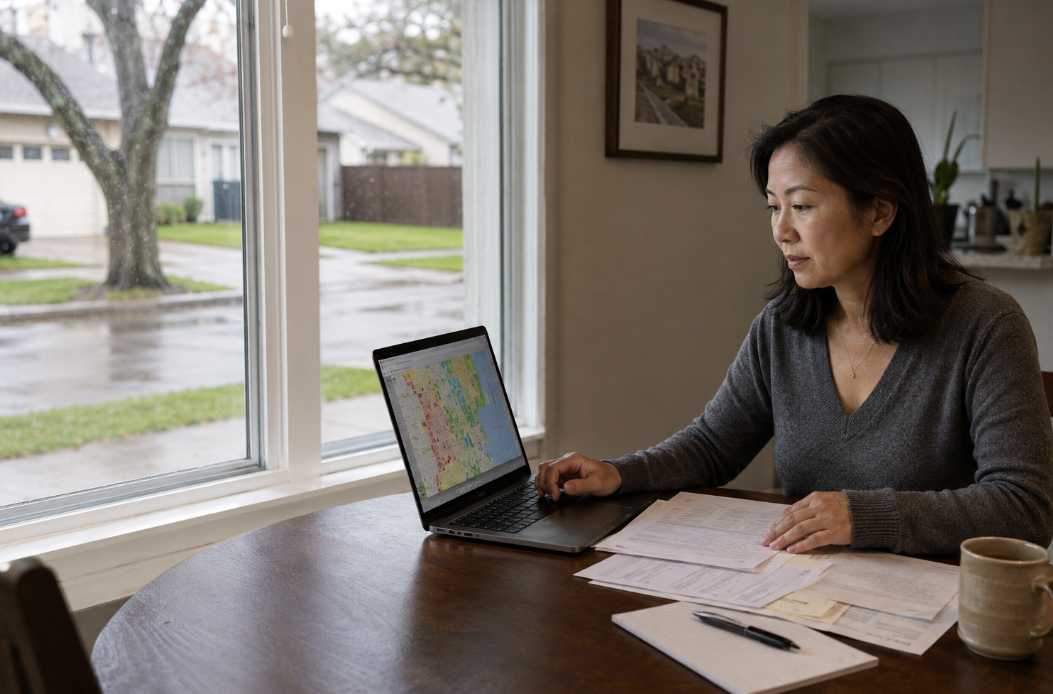
If a Houston home is outside FEMA’s high-risk flood zone, that does not mean the property cannot flood. It means the property is outside the high-risk area identified on the effective FEMA map.
That distinction matters.
A responsible flood-risk review should include more than one map. Before purchasing a Houston-area home, buyers should evaluate the FEMA designation, property and neighborhood flood history, drainage conditions, local mapping, newer predictive tools and the actual cost of flood insurance.
No map or professional can promise that a home will never flood. The goal is to replace a vague assurance such as “not in a flood zone” with enough reliable information to make a decision you understand.
What does “100-year floodplain” actually mean?
The phrase “100-year flood” is widely misunderstood. It does not mean an area floods only once every 100 years.
A property in the 1% annual-chance floodplain has at least a 1% chance of flooding during any given year. Those probabilities restart each year. Over a 30-year period, that equals at least a 26% cumulative chance.
The Harris County Flood Education Mapping Tool distinguishes among the floodway, 1% floodplain, 0.2% floodplain, coastal floodplain, watersheds, ponding areas and drainage channels.
That is already more useful than a simple yes-or-no question about whether a house is “in the flood zone.”
Why might the FEMA map be only one part of the answer?
FEMA maps perform an important regulatory and insurance function. Buyers can search an address through the official FEMA Flood Map Service Center and see the effective flood map, flood zone and available map revisions.
However, an effective FEMA map is not a prediction that one individual property will or will not flood.
Houston’s flat terrain, intense rainfall, streets that temporarily carry stormwater, changing development patterns and varied drainage systems create risks that may not fit neatly within a mapped bayou or creek floodplain.
Recent research reinforces the need for a broader review. On July 30, 2026, the Houston Chronicle reported that a Texas A&M Institute for a Disaster Resilient Texas model estimates approximately 389,500 Harris County properties may have at least a 1% annual chance of flood damage. FEMA’s current regulatory floodplain includes approximately 184,800 properties.
That model is not a new official FEMA designation, and like any predictive model, it has limitations. The difference nevertheless illustrates why buyers should not treat one map as the entire investigation. Read the Houston Chronicle’s report on the Texas A&M research.
What should a Houston flood-risk review include?
I recommend looking at seven separate information layers.
1. Check the official FEMA map
Start with the FEMA address search. Record the flood-zone designation and the effective date of the map.
Look for any Letter of Map Amendment or Letter of Map Revision associated with the property. If an elevation certificate is available, request a copy and share it with the insurance professional helping you evaluate coverage.
Do not stop after seeing Zone X or another lower-risk designation. That is the beginning of the review, not the conclusion.
2. Use the Harris County local mapping tools
For properties in Harris County, check the Flood Education Mapping Tool.
In addition to mapped floodplains, this tool can display:
- Ponding information
- Nearby bayous, creeks and drainage channels
- The property’s watershed
- Floodways
- 1% and 0.2% floodplains
- Coastal floodplain information where applicable
A house may be outside a mapped floodplain but close to a drainage channel or in an area where streets experience significant ponding. That context deserves consideration.
For homes outside Harris County, look for the equivalent flood-control, engineering or emergency-management resources serving that county or municipality.
3. Compare a newer property-level analytical tool
Buyers Aware is a free public tool developed by the Texas A&M Institute for a Disaster Resilient Texas with support from the Texas Division of Emergency Management. It allows consumers to search a property and review a statistical risk assessment.
The model considers property-level factors and historical flood-damage information. It should be treated as supplemental evidence, not a guarantee and not a replacement for an official FEMA determination.
If the FEMA map and a newer analytical tool suggest different levels of risk, do not simply choose the answer you prefer. Ask why the results may differ and investigate further.
4. Review the seller’s disclosures and available records
Read the seller’s disclosure carefully. Do not scan only for the word “flood.”
Look for information involving:
- Water penetration or previous flooding
- Insurance claims
- Drainage problems
- Repairs following a storm
- Foundation, drywall or flooring replacement
- Previous elevation or mitigation work
- Water entering a garage, building or other improvement
A disclosure is one source of information. A seller may not know everything that happened before their ownership, and neighborhood conditions can change.
Ask your real estate broker which records and follow-up questions are appropriate for the property. Legal questions about disclosure duties or document interpretation should go to a qualified Texas real estate attorney.
5. Investigate the street and surrounding neighborhood
Flood risk does not stop at the property line.
A home might remain dry while surrounding streets become difficult to travel. That could affect access to work, medical care, school, caregiving responsibilities or emergency services.
Look at:
- Whether the home sits above or below the street
- The direction the lot appears to drain
- Storm-drain locations
- Nearby detention areas and channels
- Visible grading around the foundation
- New development that may have altered runoff
- Whether neighboring homes appear elevated
- Local accounts of street or structure flooding
If practical, visit the property after ordinary rainfall. This will not recreate a major storm, but it may reveal slow drainage, standing water or grading concerns that are difficult to see on a dry afternoon.
6. Obtain an insurance quote before the option period expires
Do not wait until a few days before closing to ask what flood coverage might cost.
The Texas Department of Insurance explains that most homeowners policies do not cover flood damage. A separate flood policy may be needed even when a lender does not require one. TDI also notes that most flood policies have a 30-day waiting period, although exceptions may apply in certain circumstances. Review the Texas Department of Insurance flood guide.
Ask an insurance professional to explain:
- Building coverage
- Contents coverage
- Deductibles
- Policy exclusions
- Coverage limits
- Replacement-cost versus actual-cash-value provisions
- Waiting periods
- Whether private and NFIP options are available
- What documentation affects the quote
The amount a lender requires and the amount that adequately protects your household may not be the same.
7. Evaluate the financial and practical consequences
Flood risk is not automatically a reason to reject a property. It is a factor to price, insure and understand.
A buyer purchasing a modest starter home, a retiree buying a one-story property, a household needing accessible transportation routes and an investor analyzing rental exposure may weigh the same risk differently.
Consider:
- The annual insurance premium
- The deductible you could afford after a loss
- Whether personal property would be adequately covered
- Potential disruption if the street or home flooded
- Mitigation already completed
- Improvements that may still be needed
- How the risk may affect future resale
The correct decision depends on your finances, needs and risk tolerance, not someone else’s comfort level.
How do you put the information together?
Use a three-part framework:
Map risk: What do the FEMA, county and supplemental tools show?
Documented experience: What do the disclosure, available records, prior claims information and neighborhood history reveal?
Financial exposure: Can you obtain appropriate insurance, and are the premium, deductible and remaining uncovered risks acceptable?
Suppose a property is outside the FEMA high-risk floodplain, has no known structure-flooding history, sits above the street, shows no obvious drainage concern and has a manageable voluntary flood-insurance quote. That does not make it risk-free, but the buyer now has a more complete basis for deciding.
Now suppose another property is also outside the high-risk floodplain, but a supplemental model identifies elevated risk, the street has repeatedly flooded, water previously entered the garage and the insurance quote is unexpectedly high. That property deserves deeper investigation even though the FEMA zone sounds reassuring.
What should you do before making an offer?
Before committing to a Houston-area home:
- Search the address on the FEMA map.
- Review the appropriate county flood and drainage resources.
- Compare a reputable supplemental risk tool.
- Read the seller’s disclosure and request available supporting documents.
- Obtain homeowners and flood-insurance quotes early.
- Investigate drainage, elevation and neighborhood access.
- Decide what level of risk and expense is acceptable to you.
Whenever possible, complete the unresolved parts of this review while you still have a negotiated opportunity to investigate the property and make informed decisions under the contract.
Frequently Asked Questions
Does Zone X mean a Houston home cannot flood?
No. Zone X generally indicates a property is outside FEMA’s mapped high-risk floodplain, but flooding can occur outside that area. Review local drainage, property history and supplemental risk information.
Is flood insurance required outside a high-risk FEMA zone?
A lender may not require it, but buyers can generally purchase coverage voluntarily. Requirements and availability depend on the property, loan and insurer.
Does homeowners insurance cover flooding?
Most homeowners policies do not cover damage caused by flooding. Ask a qualified insurance professional to explain the specific policy and available flood coverage.
Can a newly built Houston home flood?
Yes. New construction does not eliminate flood risk. Buyers should evaluate the lot elevation, grading, drainage, surrounding development and available flood-risk information.
Is Buyers Aware an official FEMA flood-zone determination?
No. Buyers Aware is a supplemental analytical tool developed through Texas A&M’s Institute for a Disaster Resilient Texas. Use it alongside official maps and property-specific information.
Should I wait until hurricane season to purchase flood insurance?
No. Most policies have a waiting period, and coverage generally cannot be purchased after a storm is already threatening the area. Shop early and ask about applicable exceptions.
Make Flood Risk Part of the Buying Decision
At League Agency, we do not reduce a Houston flood-risk review to a colored box on one map.
We help buyers assemble the available information, ask better property-specific questions and bring in qualified insurance, inspection, engineering or legal professionals when the situation requires additional expertise.
If you are considering a home in the Houston metro area, send us the address before you make an offer. We will help you identify the flood-risk questions that deserve answers so you can evaluate the property with clarity.
Visit League Agency to begin your Houston home search.
League Agency | Representation at the highest level.
This article provides general real estate information and is not engineering, legal or insurance advice. Flood conditions, maps, policy terms and individual properties vary.
Author Bio
Susan McKinney is a Houston real estate broker and co-founder of League Agency, formerly Brock and Foster Real Estate, which she founded in 2003. Licensed since 2001, Susan advises Houston-area buyers, sellers and investors through complex residential real estate decisions.

Susan McKinney
Broker & Co-Founder, League Agency | League Agency RE
or another way